Tuesday, August 31, 2010
Lake Calamus Nebraska Part I
Drove to Nebraska last wknd to sail w/ sister, her husband and others, catch the action here.

Monday, August 30, 2010
Protein Builds Muscles
Dr. Gabe Mirkin's latest weekly ezine discusses the importance of protein, i.e., meat consumption, in building muscles, especially in older athletes. Read it here. For optimum results consume protein, i.e., meat within an hour following exercise.
Sunday, August 29, 2010
"It's Not About The Bike"


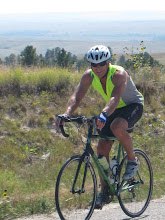
Justin and Ilana climbing the nearly continuous 5 mile long grade out of Ft. Pierre following the Native American Scenic Byway.
Sunday, August 22, 2010
Summer Fun

Every once in a while a guy just has to hang out and let the nephews dictate the play. With temps forecasted to be at or over 100 F, we opted to spend the weekend at the lake.
We engaged in a wide variety of water-related activities. Highlights included kayaking, canoeing (a midnight 3/4 moon paddle in conditions so-calm-it-was-erie), paddle boarding, body surfing and windsurfing.
A short video of the boys body surfing on Lake Oahe can be viewed here. Today these four future watermen played in the shorepound from noon to 5 only taking one break, a forced one, for lunch then back in the water for more.
Oh, what would one give to be young, again?
Thursday, August 19, 2010
Hummingbirds Journey
While finishing up a ride yesterday we met a couple on a tandem from Portland heading to New York. You can view their blog here.
Also, check out James Raia's latest, The Next Lance Armstrong, but be sure to watch the video of the kid on his way to kindergarden school on his strider bike.
Coming Soon:
The Best Dam Loop Ride in the State
Also, check out James Raia's latest, The Next Lance Armstrong, but be sure to watch the video of the kid on his way to kindergarden school on his strider bike.
Coming Soon:
The Best Dam Loop Ride in the State
Wednesday, August 11, 2010
Achilles Tendonitis: Rehabilitation & Recovery

Following 2.5 days of battling headwinds, a heavy feeling in my right foot announced itself at about mile 210 on Day 3 of the Tour de Kota last June. I dismissed the feeling and kept pedaling. A few miles later, my right achilles tendon felt like a constrictive belt had wrapped around it. Easy pedaling relieved the only symptoms -- tightness in the achilles tendon and a heavy feeling foot. Following a massage to loosen the tight calf muscle, the TdK continued, albeit at a much reduced pace, eventually racking up nearly 430 miles in 6 days.
Upon returning home, a visit to the local Physical Therapist resulted in immediate relief. As the words, "Go easy" of my PT Ami echoed in my head, reduced mileage kept me pain-free for the first two weeks. Ramping up the miles too fast returned the pain at mile 63 of a 73-miler at the end of week 5, a 300+ mile week.
Back to rehab; only this time re-injury evoked constant worry. Lowering the bike seat, moving the clips back as far as possible without drilling new holes in my shoes and every other day rides ranging from 10 to now 25 miles seems to be working. So far, so good. No pain. No tightness. No heavy foot feeling.
My latest regimen:
- stretch several times daily;
- alternate daily calf raises with riding; and
- ice when done.
Current goals: Improve strength. Gradually increase distance. Remain pain free. Do not re-injure.
Saturday, August 7, 2010
Inflatable Kayaks Make Sense

(Reprinted from River Life July 29, 2010)
Water so smooth it could be glass graced my run down Okobojo Creek and on into Lake Oahe. Numerous birds, some geese, a few fish and one deer shared the creek area as a rhythmic stroke settled in while the shoreline coasted by. Silent, serene and sublime, kayaking offers the soloist freedom unmatched by any canoe. In fact, compared to canoeing, kayaking almost seems like cheating. But, who cares?
As summer temperatures continue to soar and the strong windsurfing winds transition to mere bike-challenging breezes, thoughts turn to self-propelled water sports for an upper body workout on off-the-bike rest days. With a little creativity and minimal transfer hassles, kayaking options abound in the Pierre area including Dam runs, LaFramboise Island circumnavigations, Farm Island inspections, Cow and Okobojo Creek one ways and many others.
Getting set up with the right kayak requires some thought, but for me it was a no-brainer. However, before letting you in on my discovery, first some kayak basics.
Stretching sealskins over driftwood and animal bone frames, natives of the arctic regions of Asia, North America and Greenland invented kayaks to hunt seals along the edge of sea ice. With the paddler sewn into the boat, the original kayaks or ‘hunters’ boats’ were personalized watertight watercraft capable of maneuvering long stretches of arctic coastline in search of seals while keeping the paddler dry and warm.
Though most modern kayaks aren’t used for hunting, their basic shape originates with their Inuit ancestors. Eventually, the ancient style gave way to modern materials consisting of fiberglass and wood and transitioning to nearly bombproof synthetic hardshells. Refinements in the skin-over-frame style resulted in the modern fold-up. Recently, improvements in air bladders, synthetic skins and valves created the modern inflatable kayak.
Inflatables paddle almost as efficiently as a hardshell but have several redeeming features, including:
• Lightweight – 20-30% lighter than a comparable hardshell;
• Stowable - a trait hardshell models, except for more expensive foldups, can never mimic;
• Walkable – you can walk over the bow to enter/egress the kayak keeping feet dry and mudfree; (Try this with a hardshell and you’ll likely be reminded of a feature we all appreciate on this planet, gravity.) and
• Diveable – you can dive off bow or stern to obtain instant relief on those hot summer days floating the Missouri River from Oahe Dam to Pierre and get back in the kayak safely.
Last year I picked up two inflatable kayaks from Pedal & Paddle Bike Shop, conveniently located on main street in downtown Pierre, SD. Manufactured by Advanced Elements, Inc., the kayaks invoke the best features of a fold-up (like Folbot’s Folding Kayak) and a pure inflatable, but at less than half the cost of the more expensive fold-up.
Both kayaks, a solo and a convertible one-or-two-person model, inflate quickly, easily and hassle-free using just a hand-pump. Military grade valves allow precise inflation pressure taking less than 10 minutes to set-up. Compare that with much longer set-up times for the more expensive folding kayaks and there’s no reason why everyone shouldn’t own one of these amazing boats.
Weighing in at around 25 pounds and 55 pounds for the solo and convertible, respectively, creates a package that is as easy to cart around as it is to paddle. What more could a serious recreational specialist ask for?
I have paddled these kayaks on rivers - including the Missouri and Columbia - as well as on flat water and wind driven chop and am impressed by how well they handle the conditions. Recently, my nephew took his to Alaska and paddled on the Cook Inlet and later he ran a stretch of Skagit in Washington State.
A few weeks ago while in The Black Hills for a biking adventure we took the kayaks along hoping to use them. My wife and niece did get the opportunity to paddle both kayaks on Sylvan Lake in the heart of the Hills.
Following their adventure I deflated, packed the kayaks in their traveling bags and stowed them conveniently in our van. With the kayaks safely placed inside the vehicle, no worries about loose or broken tie-downs entered my mind as we cruised back to Pierre.
Additional features of an inflatable vs hardshell kayak:
• No roof rack or trailer needed
• Securely stored inside vehicle
• No reduction in gas mileage.
• Easy storage indoors during off-season
As opposed to tying the kayaks on the roof of the van or pulling them behind on a trailer, my gas mileage didn't decrease. Although the mileage doesn't matter much on short trips to the Hills, on longer trips the difference will likely be enough to treat ourselves to some fine micros following a hard day’s paddle.
Subscribe to:
Posts (Atom)