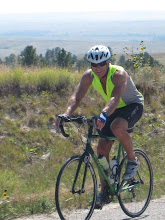
Yesterday's 47 mile ride included about 35 miles into a 15-25 mph headbreeze and snaked up two of the longest climbs in our area -- Cardiac Crest, a 325 foot, mile long humbler on 83 just south of Ft. Pierre and the adjacent 5 mile long 300+ foot climb up to the Buffalo Interpretive Center on 1806. Time trialing, i.e., riding solo, not only increases stamina but also consumes a lot of calories.
Nutrition on the bike can be as, or perhaps, more important than nutrition after the ride, especially for rides exceeding 2 hours. Proper nutrition while riding allows a faster and fuller recovery and we all know that the faster you recover the sooner you can ride hard again. So, proper nutrition becomes critical to ensuring a quality training regime, especially as you head toward your season's peak.
According to Hammer Nutrition, rides lasting longer than 2 hours require additional nutrition and special electrolytes beyond the usual sodium and potassium found in most electrolyte beverages. Specifically, longer rides require the cation magnesium to allow continued exertion at or near lactate threshold for extended periods of time. The supplemental nutrition needed to complete longer rides without feeling totally drained must contain the right mix and type of electrolytes, carbs and protein. The optimum on-the-go combination refuels the muscles keeping them awash in nutrients essential to maintaining proper oxygenation, hydration and fuelization.
For me select Hammer Nutrition and Clif products provide the basics needed to fuel long, hard rides. Hammer Nutrition's easily digestible products that seem to work the best include:
- HEED (High Energy Electrolyte Drink),
- Sustained Energy, or for really long rides,
- Perpetuem.
For me, mixing equal parts (1 level scoop of HEED + Sustained Energy or HEED + Perpetuem) in a single water bottle seems to work well; however, the label calls for 3 scoops of Sustained Energy. Experiment on rides of varying length and intensity to find your optimum mix. These essential energy sources allow the hard-charging rider to keep on charging without worry of bloating, heartburn or nausea commonly associated with intensive exertion using "regular" food as fuel.
Clif Shot Roks, a protein supplement billed as a "post-activity recovery" product comes in convenient single serving packets providing 20 grams of protein in 2g bite sized, amazingly assimilatable and tasty portions. The Shot Roks satisfy the yearning for solid food that always awakens around mile 30 or so. Keep the Roks stashed in a back jersey pocket along with a flask of Hammergel to provide all the extra energy needed to complete a 50+ miler when the going gets tough.
Thursday, May 20, 2010

Sunday, May 2, 2010
When You Feel Good ... Go Long
When the weather and training goals coincide do not hesitate -- go for it. By it, I mean, a longer ride than scheduled on your training plan. Not only does a longer ride provide a quantitative test of your current fitness level, it also builds confidence crucial to the mental portion of your early season training regime.
Spring weather on the Northern Great Plains serves up a mixture of cool temps, wind, rain and more wind. Occasionally, high pressure enters from the west bringing with it calm wind, clear skies and temperate temperatures. Last Tuesday, the cycling friendly high pressure system smiled on us creating calm, sunny and cool conditions -- perfect riding weather.
The ride followed the new, smooth, wide-shouldered highway 1804 south from the Oahe Drag Strip, about 15 miles north of Pierre, and continued up/down Snake Butte, through Pierre, Ft. Pierre and continued southeast on Highway 1806 past the Lower Brule Buffalo Interpretive Center. The synergy of the stellar sunshine and no wind combined with the pristine prairie panorama enticed me on. After hammering the rollers, the ride dropped down off the tableland into Antleope Creek drainage and up the other side. At mile marker 161 I turned around and headed back.
Near Highway 83/1806 intersection my wife met me and back up to the LBBIC we went before turning around and following Stanley Trail back to the dam, 1804 and to my starting point near the drag strip.
Stats:
98 miles
2690 feet
Monday, April 26, 2010
Hills in the Hills
"Thar's gold in them thar hills!" mostly anonymous 19th Century prospectors proclaimed as they wound their way from eastern locales to the northern Black Hills. The gold drew men searching for riches like a moth to a flame. Some made it big; most did not.
By today's standards four billion dollars worth of gold came out of the Black Hills with a large amount of it mined from Homestake near Lead. Though Homestake no longer mines gold; particle physicists from around the world plan a new type of mining for Homestake -- now Sanford Laboratory. The mining consists of excavating large underground chambers and constructing super-sensitive physics experiments. The future of Homestake as America's flagship Deep Underground Science and Engineering Laboratory should guarantee it a prominent place in the particle physics world for many years to come.
Gold fever disappeared about as fast as it arrived in The Hills as prospectors went their solitary ways. But, towns sprang up and civilization spread throughout the Black Hills as lumber, ranching and tourists replaced the gold seekers. Fairly recently, discoveries of a new type of gold perfuse the internet as local mountain bikers share the secrets of their Black Hills trails.
Lately, roadbiking, centered on The Hills, showcases the smooth blacktop, low traffic, incredible scenery and plentiful wildlife as one company, Dakota Bike Tours, leads the way.
Recently, Albuquerque transplant Jeff Patterson, opened a bike shop, Cranky Jeff's, in Rapid City and is ecstatic about the plentiful road biking.
Likely others will follow Jeff and discover the outstanding road biking saturating The Hills.
The equipment needed to mine the new gold are bicycles -- man's most efficient machine powered by good old fashioned muscles. These human-powered conveyances take the determined rider up into The Hills where the new gold just waits to be discovered.
For a rider basing out of Rapid City, one of the first places for discovering the new gold starts at about 3400 feet at Canyon Lake and follows up Park Drive and up Sheridan Lake Road, as a nice warmup to the eye-opening 6% grade up Catron. Just before the light on Highway 16 take the Service Road south toward Reptile Gardens. At Reptile Gardens hang a left on Neck Yoke and settle in as you pedal, mostly up, take a left on Rockerville Road and ride the rollers to Keystone. Refuel from the last 1000+ feet of climbing at Iron Mountain Coffee on mainstreet as you plan your nearly continuous 1200+ foot climb up scenic Iron Mountain Road to elevation 5460 where the new gold awaits you at the summit of the Norbeck Overlook.
Savor the view of Mt. Rushmore, Harney Peak and the eastern plains before pointing your iron steed down, down, down and rocketing through 3 tunnels hewn in 2.5 billion year old PreCambrian granite over 3 cleverly crafted pigtail bridges and along 2 single paths on the way back to Keystone. Regroup and retrace your trail back to Rapid but hang a left on Moon Meadows and jog over to Sheridan Lake Road before blasting back to Park Drive and eventually Canyon Lake.
As you coast down Sheridan Lake Road cogitate on the new gold you've discovered in the Black Hills and maybe, just maybe, one of your riding companions will exclaim:
"Thar's hills in them thar hills!"
Stats:
Under typical Hills spring weather (i.e., cool, partly becoming mostly cloudy) and incredibly light traffic I covered about 55 miles and climbed over 3400 feet last Wednesday.
Friday, April 16, 2010
Rough Riders, Really!
Can you ride a road bike on a gravel road? How about a dirt road? Yes, as long as a dry surface greets the rubber where it meets the road. My road bike -- actually a Salsa Chili Con Crosso Scandium with carbon fork, stem and handlebars matched with Shimano Ultegra compact drivetrain (custom-built at the Pedal & Paddle Bike Shop in Pierre, SD) -- begged for some off-pavement exploring recently. What better way to turn a normal, routine, see the same scenery twice out-and-back into a new adventure?
My escapade started at the causeway in Pierre and followed 1804 up Euclid, up Snake Butte, across the dam heading west up/down Gut Check Hill across the Emergency Spillway, which, by-the-way is about as full as it can be, up Big Ass Kicker continuing west on 1806. Sixteen miles later, at the Cut Across Road/1806 Junction, I hung a left and followed the mostly smooth tire trail on the gravel road for 3.1 miles smiling hugely while enjoying wind-aided speeds registering comfortably in the low 20s.
The Cut Across Road connects with 14 and the newly paved surface together with the wide smooth shoulder combined with a 15mph NW tailwind made the 8 mile ride into town a breeze. While on the Cut Across Road a local farmer riding his tractor gave me a full arm wave. Talk about friendly!
Consider adding the Cut Across Rd. Loop into one of your next training rides. You'll be glad you did.
Stats:
27.2 miles
673 feet of climbing
Wednesday, April 14, 2010
Windy!
Strong southerly winds blew up an OK swell yesterday on Lake Oahe. Both my nephew and I windsurfed primarily in the mouth of Cow Creek for a couple hours. We finished just as the wind ramped up a notch from 30-40mph to gusts hovering in the upper 50s. A small point break formed on the Okobojo Pt. side of Cow Creek making for decent rides and jibes. A short video of my nephew sailing can be viewed here.
Once the big winds filled in we both agreed that the session satisfied our high wind craving as we happily de-rigged. While de-rigging we recounted our previous two days of sailing and wondered if this streak heralded a change back to a weather regime more conducive to windsurfing than bicycling. Time will tell.
Once the big winds filled in we both agreed that the session satisfied our high wind craving as we happily de-rigged. While de-rigging we recounted our previous two days of sailing and wondered if this streak heralded a change back to a weather regime more conducive to windsurfing than bicycling. Time will tell.
Wednesday, April 7, 2010
10 Weeks to a 6-Day Multitour
The Tour de Kota starts June 6 and covers about 478 miles in 6 days, including the optional century on the last day. The 6th Annual TdK begins in 9 weeks and training miles really become important. The miles you ride now allow the TdK to be pleasureable, not burdensome. But you have to do your homework. Otherwise, when the final exam occurs you might not pass with flying colors.
Endurance training guru and author, Joe Friel dispels the myths frequently associated with aging and shows the right way to train for your first 6-day multitour in his book Cycling Past 50. Available in most public libraries you might want to purchase your own copy of this incomparable treatise for future reference. Friel illustrates the proper way to train for long multiday tours and based on my experience his advice works extremely well.
A few years ago, following hip re-surfacing surgery, road biking became my preferred rehabilitation exercise. Within a few months I discovered Friel's "how to" book for senior cyclists and put his advice to the test. The results stunned me. My first multiday tour, the 2007 Tour de Kota, traversed 475 miles of Eastern South Dakota and I have the badges to prove it! That tour channeled an exhilirating physical and mental rejuvenation breathing new life into my arthritic-ridden joints.
Now, training for my 3rd TdK -- while my wife trains for her second -- we both subscribe to Friel's sage suggestions contained in Cycling Past 50. If you're searching for a tried and true training approach to a 6-day multitour get yourself a copy of Friel's outstanding book and start doing your homework.
Tuesday, April 6, 2010
Rapid Recovery Ride
Recovery rides increase circulation and speed up recovery from intense training rides like intervals, individual time trials or hill climbs. According to author Joe Friel in his tome The Cyclists' Training Bible most self-coached racers do not ride hard enough on the hard days and they do not ride slow enough on the recovery days. The combined not-hard-enough and not-easy-enough approach to training results in most rides being done in what professional trainers refer to as "No Man's Land." Spending too much cycling time in this zone -- not hard enough to tax the anaerobic system but too hard to recover -- leads to stagnation and eventually burnout.
Friel defines recovery riding as a ride at an effort that does not elevate the heart rate above about 100 bpm. A good rule of thumb to follow during a recovery ride involves a simple self-check on pedal pressure -- if you feel the pedal lighten up and spin easily. Nominally, about a 12-14 mph average qualifies for a good recovery pace as long as the route is flat and shielded from wind.
One of my favorite recovery rides follows the bike path along Rapid Creek in Rapid City, SD. Starting on the west side of town at Canyon Lake the bike trail meanders about 7 miles to the fairgrounds forming a perfect 14 mile or about an hour roundtrip recovery ride.
If you do the recovery ride right your legs will be begging you to let them go and chase whoever overtakes you. But, resist the urge and pedal your recovery cadence. Soak up the scenery, the sun and reflect on the beauty of the Rapid Creek valley. Alternately, plan your next long ride in the hills as you give your tired legs some active rest. If your previous intensity workout hammered you more than normal you might want to double down on the recovery rides and be in a much better shape to tackle the longer rides when your legs feel ready.
Subscribe to:
Posts (Atom)