Sunday, May 20, 2012

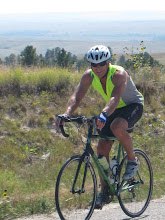
Wellmark Tour de Oahe: 68 miles To The End Of The Pavement (On 1806) And Back


Distance: ~68 miles -- Estimated riding times (excluding breaks): Fast Group: ~3.75h, Medium Group: ~4.5h, Social Group: ~5.5h).
Climb:        1750 feet, Cat 4, Cat 5 (2) + several uncategorized hills.
Difficulty: Hard, especially if the wind picks up around mid-morning. 

In olden days danger waited uncomplainingly at the end of the road for anyone foolish enough to challenge the limits of civilization.  Yet, folks frequently pushed the perimeters and many found a new life in an unfamiliar country while some became statistics that historians like to write about.  Regardless, the pioneers who survived the extreme prairie hardships paved the way for the rest of us following in their horses hoof prints.  

Today trails made by those hoof prints beckon our iron steeds propelled by a magical mixture of muscle power and mechanical ingenuity forming the most efficient machine yet invented by man.  The bicycle, according to William Fotheringham’s Cyclopedia: It’s All About The Bike, 

is simultaneously a piece of high-tech sports gear, a means of transportation to work or the store, a way of discovering the world, an escape to solitude and nature, a social network that beats any of the virtual variety, and a means of discovering your personal limits …

Route: Start at Oahe Downstream Group Lodge, take an immediate left, go about 0.3-mile, take a left and pedal past the Campground Fee Station taking a right at the “T.”  Follow Oahe Downstream Rd toward the powerhouse turning left up the first rated climb of the ride:  a 0. 64 mile Cat 5 averaging 2.1% (see below). 

At the top of the dam hang a left and recover on the 2.3-mile perfectly flat dam crest while you gaze at the magnificently massive Lake Oahe.  Check the water’s surface for telltale ripples, harbingers of wind yet to mix down from higher altitudes as another beautiful summer day unfolds before your very eyes and say a silent prayer that the wind takes a vacation today.  

Take a right on 1806 maintaining high cadence and steady rhythm up a gentle rise leading to an unrated humbler known as Gut Check, drop down GC being cognizant of the 5 mph turn at the bottom, put the hammer down across the Emergency Spillway and settle in for yet another unrated short but sorta’ serious climb known as Big Ass Kicker (8-10%). 

From the top regroup with your buddies and pace to the first rest stop at Chantier Creek Store at about mile 17.6 where porta-potties, snacks and fluids await. Top off the tank ‘cuz it’s about 11 miles to the next rest stop at the Triple U Buffalo Ranch. 
Although several small hills exist on this section of the route a 3-mile Cat 5 climb averaging 2.3% patiently awaits you at mile 24.7.  Be sure and save something for the return trip when you get to climb it going the other way back to base camp.  Further on down the road your path crosses some of the territory memoralized in the film Dances With Wolves as the buffalo scenes were shot on the Triple U Buffalo Ranch.  Keep your eyes peeled and the shaggy beasts may just appear out of nowhere.

A porta-pottie, snacks and hydration drinks, courtesy of First National Bank, provides everything you’ll need to either make it another 4 miles to the turnaround or to get back home. Once refreshed, saddle up and retrace your route back to the Group Lodge recognizing that the last rated climb at about mile 46 – a 2-mile Cat 4 averaging 2.6% -- stands between you and a cold beer.  

See you back at base camp where a picnic lunch courtesy of Fisher Rounds can be enjoyed while reveling in the excitement of the rides with old and possibly some new friends.

Hazards:  Cross traffic at intersections, 5 mph turn at the bottom of Gut Check (westbound), gravel in Chantier Creek Store parking lot and likely on the road’s shoulder at the entrance, parallel grooves along 1806 at various locations, usually light traffic, rattlesnakes.


Profile: Jim Dial, Owner of Pedal & Paddle Bike Shop

Nearly 15 years ago Jim Dial became the owner, operator, chief mechanic and bicycle guru at Pedal & Paddle bike shop located in downtown Pierre, SD.  Featuring cost-effective Raleigh road bikes as well as a variety of comfort, hybrid and mountain bikes Pedal & Paddle has something for just about everyone. If Jim doesn't have your dream bike in stock he can order it and it'll be here before you know it.  Jim will assemble and tune your new bike to fit you, not conversely like those big box store bikes where you must fit the bike.

Therein lies the rub, sure you can buy a bike cheaper on the internet or at Walmart but neither of those two outlets have any mechanics, let alone a knowledgeable, experienced one like Jim who takes personal pride in making sure that the bike you buy from him is the right bike for you.  Take me for example, following hip resurfacing surgery I decided road biking made more sense than my then love of mountain biking and Jim ordered a frameset on a closeout fall deal and over the winter he ordered and installed the gruupo I'm still using and that was over 5 years and 20,000 miles ago -- all I've replaced is the chain and the rear cog on my Shimano Ultegra gruupo -- and there're many more miles left in it.

So, if you're in the market for a new bike or just want to make sure that your current ride is tuned and ready to ride the Wellmark Tour de Oahe this June 30 take a spin down to Pedal and Paddle, you'll be glad you did.

Friday, May 11, 2012

Training For The Wellmark Tour de Oahe

Although challenging weather conditions continue to make it difficult to find the motivation to train for the Wellmark Tour de Oahe, the weather should make a drastic change for the better starting tomorrow.  Saturday's weather in the Pierre area should be perfect for cycling -- not too warm, not too cool, but best of all light wind.

Pierre riders plan to meet at the convenience store on North Euclid at 9am Saturday with riders of all abilities welcomed.  Our motto: We leave no behind behind means that someone will ride with you regardless of how early in your training program you may actually be.

It matters little what kind of riding fitness you possess. What matters is that you start and there's no better time to start than now.  If you stick to a decent training plan that incorporates the features outlined here, you should be in good shape to tackle whatever distance suits your fancy come June 30.

Wednesday, May 9, 2012

Post-Cycling Muscle Soreness

After a particularly good ride, or, perhaps a prolonged effort into the wind (like my ride home yesterday) you might experience some soreness in your leg muscles.  According to Dr. Gabe Merkin, an avid cyclist, some muscle pain is a good thing indicating you just had a decent workout.  Dr. Merkin recommends going easy the day after a hard ride until the muscle soreness dissipates before resuming a vigorous workout regime.

Thursday, May 3, 2012

Record Registration for Wellmark Tour de Oahe

As of today registrations for the Wellmark Tour de Oahe, now in it's second year, continue at a record-setting pace. Currently, we have received over 60% of the 150 paid rider registrations and expect that number to increase quickly as word gets out about the upcoming June 30 ride staged near Pierre, SD.  Already we have riders registered from as far away as Montana, Tennessee and Wisconsin as well as Iowa, Nebraska and, of course, South Dakota.

For a mere $35 through June 1, you'll receive registration for one of the 3 rides (20, 35 or 68 miles), two meals (delicious pre-ride dinner Friday night and satisfying post-ride lunch on Saturday), all snacks and energy/electrolyte drinks, a breathable T-shirt and other swag items.

On June 1 registrations increase to $45 and registrations close for all fee-based rides on June 27.

In addition to the paid rides we have planned a free Family Fun Ride and a free Kid's Strider Bike Challenge Course.  These activities although free still require registration by following the instructions posted on the website.

So far >60% of the self-imposed limit of 150 riders has been met -- these folks are training and looking forward to a great ride. There's still room for you to join us. Don't delay, sign up today!

Friday, March 2, 2012

Don’t Worry, Be Happy: Train With A Power Meter – Part II – Results!


One way of looking at power meter training might be the following analogy. How much would you spend to get a 15% increase in gas mileage in your current vehicle? If you drive about 20,000 miles per year at $4/gallon (might go much higher this summer) a 15% increase in mileage would save you over $500 per year. Remember that number.

Since starting training with a power meter on July 28, 2011, coached by Carmichael Training Systems’ Expert Coach Clayton Feldman I’ve gained nearly 15% in my Functional Threshold Power (FTP) – with much of that training performed indoors in good old SoDak. Defined as the average wattage produced at Lactate Threshold (LT), FTP is the Gold Standard for power meter testing.

Impossible to fake, FTP is your base aerobic fitness level and the only way to increase it significantly is by structured interval training at or above your LT. The only efficient way to interval train is with a power meter. Likewise the only smart way to train with a power meter is to hire a coach from a reputable organization and follow his workout instructions exactly.

Do these things: buy a power meter, hire a coach, follow his instructions and prepare to be amazed. Add in motivation, commitment and nutrition, all parameters within your sphere of influence, and you have derived the equation for personal improvement on the bike. Now, if you also happen to possess two genetically-determined variables, namely Talent and Trainability, you have all the ingredients necessary for a successful bike racing recipe.

So what does all this have to do with gas mileage? You can think of power training as analogous to improving your vehicle's gas mileage -- for the same amount of effort, i.e., heart rate, you get more power as measured by the power meter quantitatively in watts. An instantaneous read out on the headset conveniently mounted on your stem keeps you training in the proper zone for the prescribed time to achieve optimum results.

Monday, February 6, 2012

Don't Worry, Be Happy ... Train With A Power Meter! Part I

Do you worry about whether or not you're training hard enough, or, if your recovery rides are easy enough? Or, if you are like I used to be you don't concern yourself with the incidentals, you just want to ride your bike (as much as schedule, weather and physical limits allow). Most recreational cyclists I know simply ride their bike, picking up the tempo on the hills or during select sections of infrequent group rides. Although this routine builds endurance it doesn't do much to build strength. In order to build strength you have to do intensity, i.e., intervals. By riding intervals, preferably almost to failure, the leg muscles gain strength through predictable physiological improvements. But, how do you know how hard to do the intervals?

The Old School methods involved either a heart rate monitor or RPE (Relative Perceived Exertion), both measures of input, not output, as thoroughly discussed in Alex Hutchinson's latest book, Which Comes First, Cardio or Weights?: Fitness Myths, Training Truths, and Other Surprising Discoveries from the Science of Exercise. In order to measure output you need a New School method (i.e., power meter). The power meter incorporates metal strain gauges either in the hub or crank arm, readout on a headset (which can be downloaded for precise quantification of output, i.e., work) and is reproducible from one workout to the next (regardless of the route, weather conditions, your temperament, etc). The most useful measure of output (work) is watts (power) and power-to-weight ratio (Watts/Kg) is the single most important quantification of climbing and overall riding ability as detailed in Training and Racing With A Power Meter by Hunter Allen and Andrew Coggan.

As Allen and Coggan explain, simply bite the bullet, buy a power meter and start training smarter. Their book provides a cookbook approach to power training and can be useful to determined riders. Another way to go is to hire a coach at the same time you buy your power meter. A coach comes in darn handy, he walks you through the steps required to get the power meter/website wired and he also serves as your mentor, assigning workouts, analyzing power files and passing judgement on your efforts.

As my coach always says, "You've done the hard work. You get to enjoy the results." The hard work he's referring to are intervals and the enjoyment comes from seeing your average power numbers increase in response to your training.

Part II: The Results